 MG Car Club

By Peter Cook
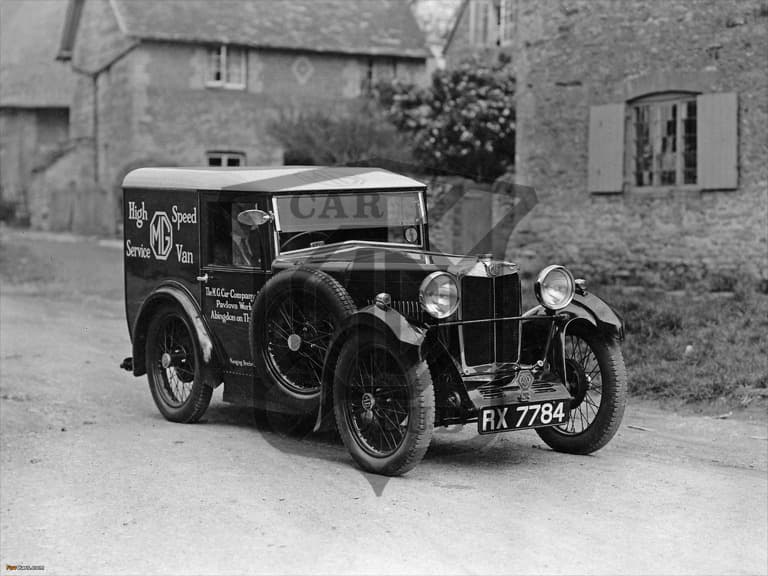
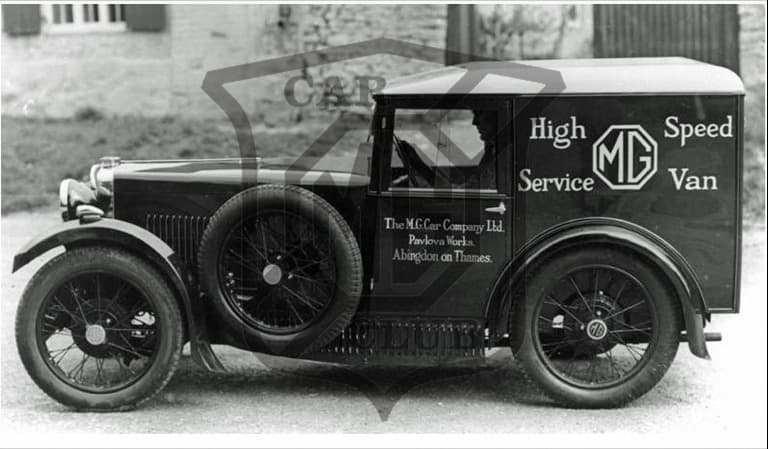
ABINGDON’S FIRST PRODUCTION VAN
I am currently digitising the Club’s MMM production archives, a mammoth task. The archive is extensive for a number of reasons. It covers the period from 1929 to 1936when there were numerous models, but mainlybecause the factory not only made cars and needed to deal with guarantee claims, but it also serviced and repaired MGs including repairs for accident insurance settlements. From what I can tell, post WW2 repairs, servicing and insurance work was conductedby afactory-approved dealer network.Given the size of the MMM archive, ‘From the Archives’ is likely to be a series of articles,given the presence of still-remembered names and unusual circumstances and correspondence.
The MMM archive is organised by model and chassis number, so the first part of the overall task has been to digitise the ‘M’ Type Midget files. It is worth pointing out that Kimber House has such a large collection of chassis files only because,when the factory was being closed –and contrary to management instructions –Mike Allison and some other employees and Club members spirited out of the factory as many files as they could. OnceKimber House was eventually established as the Club HQ in 1990,the MMM as well as other files were moved there permanently.
While the files are organised by chassis number, the first document to be found is the identity of the purchaser, their address, and date of purchase. Most names don’t mean anything today, but some do stand out as prominent,and for Midget chassis number 773 sold on January14, 1930,the owner of the Edmund Road-produced car was Michael D’OylyCarte (for brevity MDC) of 6, Derby Street, London W1. The car was purchased from University Motors, also in W1.
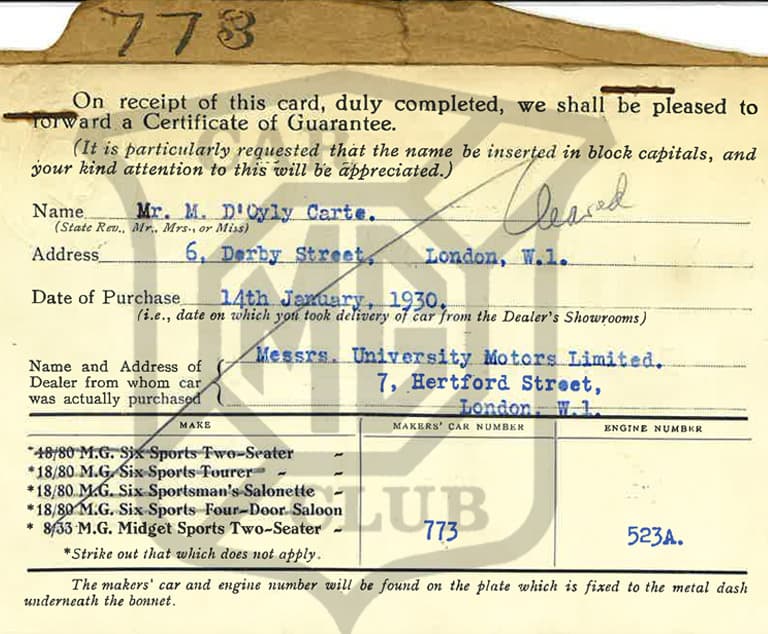
1. The first owner of M773
Of course the name D’Oyly Carte rang a bell and Michael, then aged 19, was due to eventually take over the running of the opera company from his father, Rupert. This did not happen because Michael was killed in a motoring accident in Switzerland, aged 22. It was a head-on crash with a local motorcyclist. The Times newspaper reported:
‘Had Michael lived he would have become chairman of the Savoy, Berkeley and Claridge’s hotel companies and also proprietor of the Gilbert and Sullivan troupe his grandfather founded about 1870.’
Bridget, Michael’s sister, who previously had no wish to be involved with the company, stepped into MDC’s shoes and eventually took over the full running of D’Oyly Carte in 1948 until its demise in 1982.
The D’Oyly Carte Opera Company was established in the mid-1870s by theatre owner Richard D’Oyly Carte to solely produce the light operas of WS Gilbert and Arthur Sullivan. The intention of the founder was to produce light opera which was midway between Grand Opera and the less respectable Opera Bouffe, with its elements of comedy bordering on slapstick, and originating in Milan as something light in the intervals between serious opera performances. D’Oyly Carte toured throughout the UK, Europe, North America and Australasia until 1982, when it was disbanded due to rising costs and an inability to obtain Arts Council funding, which went to more ‘serious’ opera. Also, financial matters were not helped by copyrights expiring in 1961, for up until then the company received much income from amateur operatic performances. The productions included The Mikado, HMS Pinafore, Trial By Jury, The Pirates of Penzance and others. So initially successful was D’Oyly Carte that both the Savoy Theatre and the Savoy Hotel were built using opera profits.
What of chassis number M773? What do the files reveal? Although purchased on January 14, 1930, by April 22 the same year MG wrote to MDC informing him that a garage would be sending M773 to Abingdon in a badly damaged state for an assessment for repairs, and that an insurance engineer would be expected to visit soon. On May 7, MG Service Manager Mr JR Temple wrote to the insurance assessor stating:
‘We beg to inform you that the above car (M773) reached our works yesterday afternoon, and as soon as possible we shall strip the chassis and prepare an estimate. We would advise you that this car is very badly damaged indeed, and it will have to be completely dismantled.’
The damage was surprisingly extensive, and involved not just the expected damage to bodywork, lights, radiator etc, but included bell housing, distributor and starter, and possible damage to the crankshaft. By May 19 the estimate for repairs was sent to the assessor and the total repair bill was stated as £132-12-4, with an estimated repair time of three weeks. To put the cost in context, when the Midget was launched at the 1928 Motor Show the retail price was shown as £175; in late 1930, after some notable sporting successes, the fabric version for 1931 was listed as £165. We do not have the assessor’s or the insurance company’s correspondence, but from what transpired later it is clear that M773 (GC 499) had become an insurance ‘write-off’.
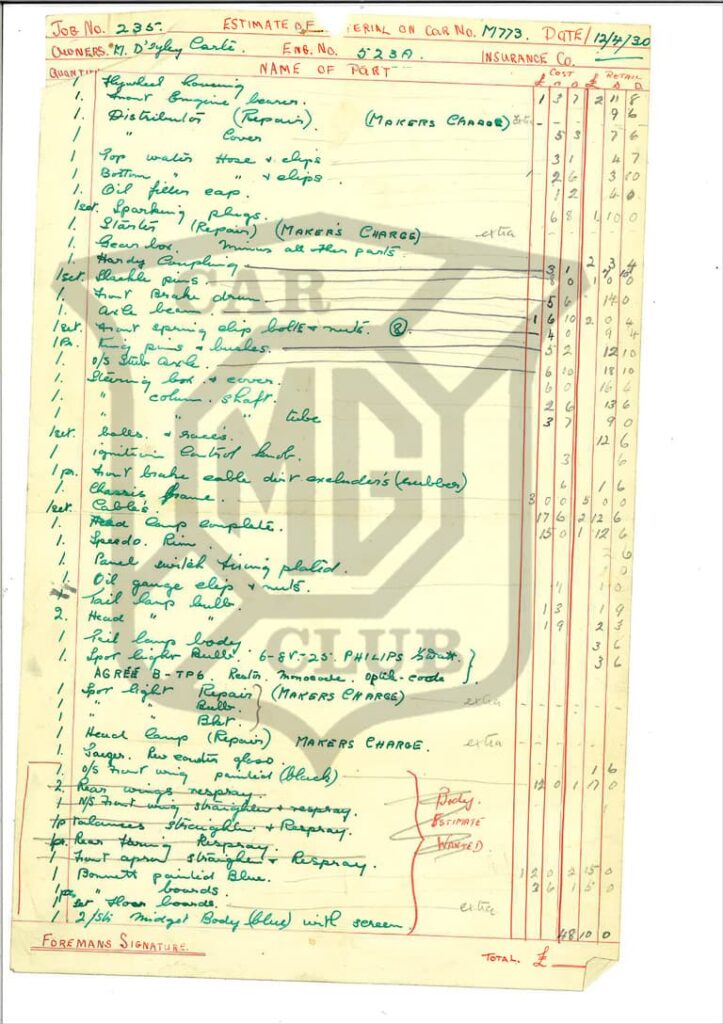
2. Part of the damage quote for M773
Perhaps rather oddly, on May 28 the factory received a package from MDC which contained the following, among other items: a radiator muff, a rev counter cable and head, two electric horns, a spot lamp, an oil can, a bag of tools, and a box containing plugs etc. All the items were likely kept separate from the Midget and may be regarded as spares, or in the case of the spot lamp and the rev counter, items which it was intended to fit to the car at some point. But given what later transpired, sending the items to Abingdon may after all have made some sense. MDC seems to have taken the insurance payout and switched his allegiance to another marque, for by June 5, matters became clearer as MG wrote to MDC as follows:
“As we are rather anxious to clear out of our shop the remains of your Midget, we are wondering if you will be good enough to let us know whether any of these parts are required or whether we may scrap the lot. Thank you in anticipation.”
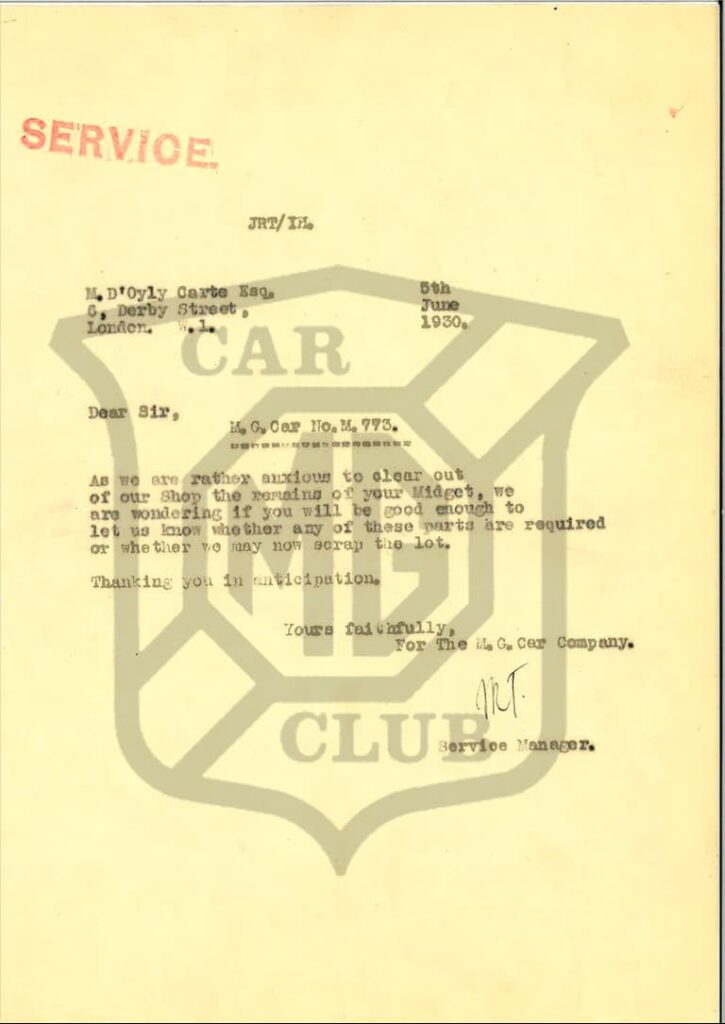
3. Copy of the letter asking to clear the remain of the Midget
Abingdon does not appear to have received a response, for Mr Temple wrote again on June 30:
“We are very sorry to bother you again over this matter, but as we are very anxious to get the remains of your car out of our Service Department we should very greatly appreciate your information as to whether there are any of the parts which you require.”
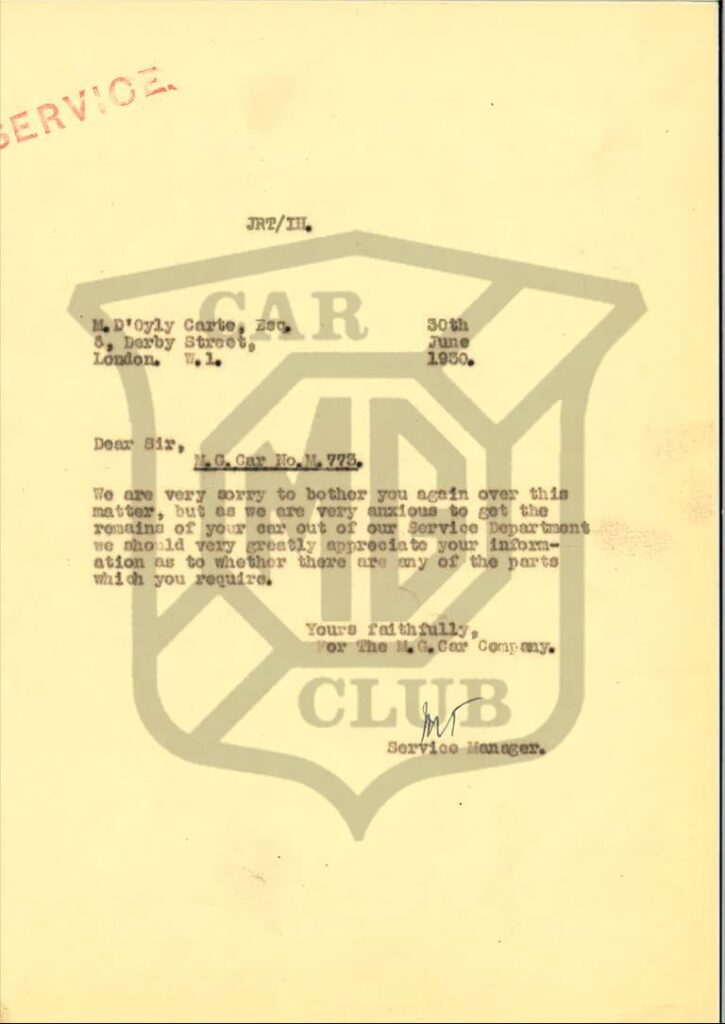
5. Copy of the penultimate letter, asking to remove the remains of M773
Unfortunately the archive files – with few exceptions – contain only the correspondence, both external and internal, issued by the factory. Owners’ letters are rarely included, so to an extent it is somewhat guesswork in many instances as to what actually transpired, but in this instance it is clear that MDC did not respond to MG’s request to make a decision on what was left of GC 499, for on July 15, nearly six weeks after the first request, Mr Temple wrote for the third time:
“We would refer you to our letters of June 5 and June 30, wherein we asked you if there were any parts of the above Midget which you required, or whether we might scrap the lot. We do not appear to have received any reply from you, and unless we hear within seven days we regret we shall have to dispose of the remains of the car, as we wish to make use of the space which these now occupy.”
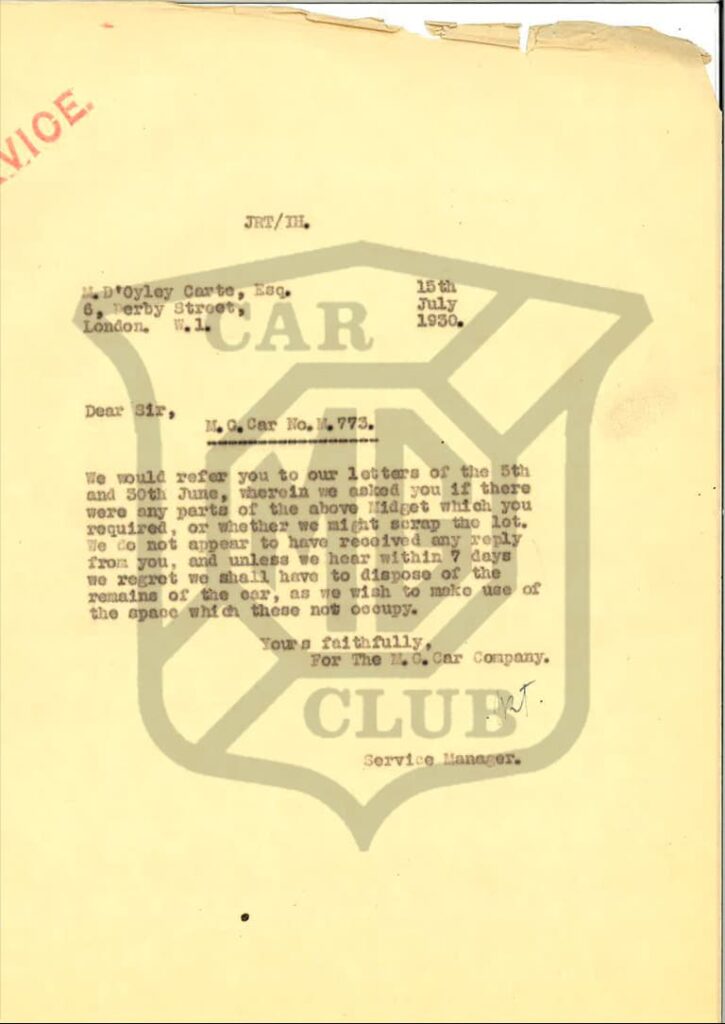
6. Final letter to Michael D’Oyly Carte
We might assume that this letter got no response, or at least an unhelpful response, as the badly damaged, stripped down Midget did not leave the factory. Over three months after the final letter, George Propert, the General Works Manager, issued an order for repairs on October 28, stating:
“Rebuild chassis (773) for work use. All old material to be used wherever possible and when replacements are needed apply first to Experimental Dept. and Unit Shop etc. for surplus used material. Costs are to be kept to a minimum.”
Chassis 773 (GC 499) was now referred to as ‘ex-D’Oyly Carte’.
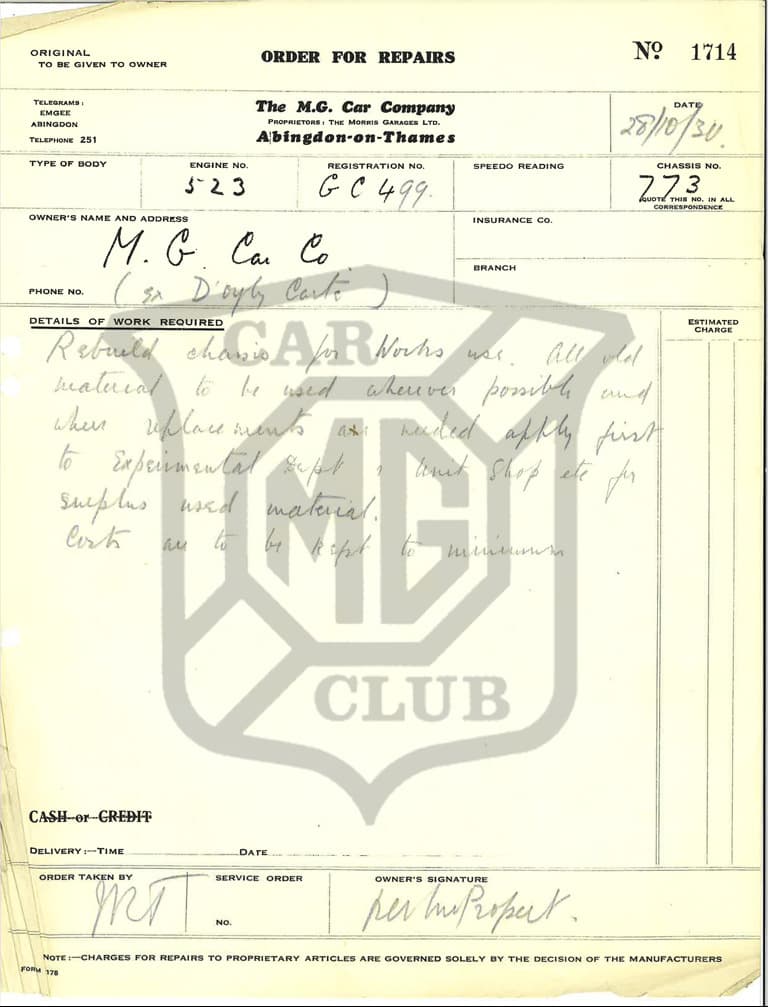
7 Letter from Propert instructing that M773 be rebuilt for works use
GC 499 was resurrected as a fully complete functioning vehicle, but not as a Midget and not as GC 499. A works order for repairs on May 13, 1931 now described chassis 773 as a ‘Midget Van’, and although the chassis number remained the same, the registration number was now RX 7784, indicating that, although a works van, it needed at times to travel on public roads.
The file shows that RX 7784 underwent many repairs typical for a 1930 Midget, with the last factory document indicating that it was still in service on May 11, 1933. In March 1932, chassis 773 was involved in another accident, but the file does not indicate culpability.
MG’s brief foray into van production was unplanned, and a response to a set of circumstances of somebody else’s making, but as with many MG factory stories, the staff made the best of the circumstances they were faced with at the time.